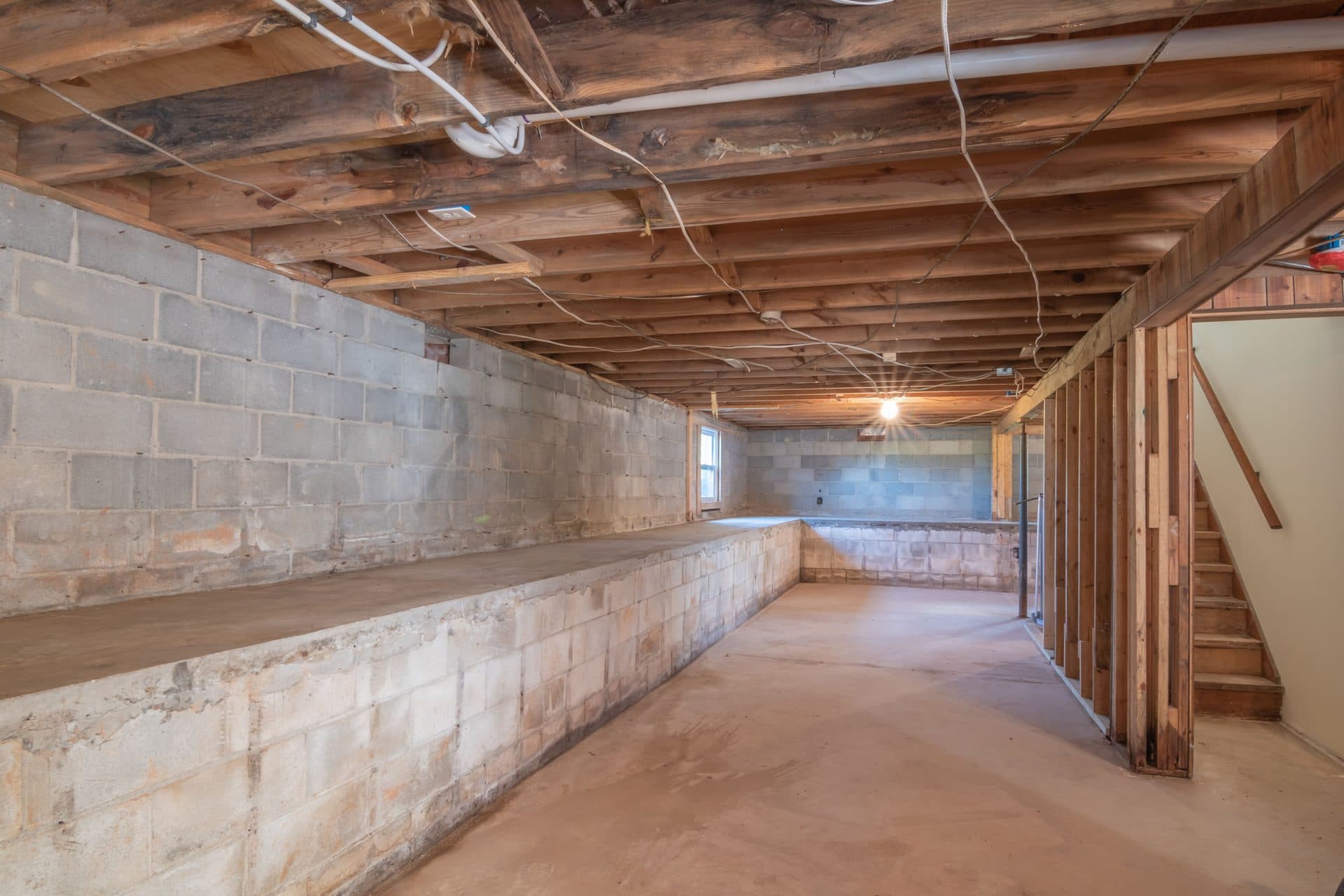
Wet Basement Repair in Jamestown, NY
Water in the basement always comes from somewhere specific. Find the entry point and the repair gets simple. Skip that step and you buy a system you may not need.
Where water actually gets in
Standing in a wet basement, every leak looks the same. But water leaves evidence, and the entry point determines the fix. These are the ones we find most often in this area.
The floor and wall joint
The seam where the basement floor meets the wall is not sealed in most older homes, and it is the single most common entry point we see. When groundwater rises under the slab, it comes up through that joint. Water appearing along the base of the wall, in a line, usually after a wet stretch, is the signature. This is what interior perimeter drainage is designed to intercept.
Cracks in the wall
A leaking basement wall with a visible crack is the most straightforward case. Poured walls crack vertically as they cure, and those cracks let water through under pressure. Injection seals them through the full thickness of the wall. See foundation crack repair for how that repair works.
Through the block itself
Concrete block is hollow and porous. Water can fill the cores and weep through the face without any crack at all. The tell is white chalky residue on the wall, called efflorescence, which is mineral left behind as water evaporates through the block. Damp patches that come and go with the weather point the same direction.
Over the top of the foundation
Where the ground outside sits too high against the house, or has settled into a bowl near the wall, water runs over the top of the foundation and down the inside. This one is often fixable from the yard rather than the basement, which is worth knowing before anyone sells you a drainage system.
Window wells and pipe penetrations
Wells that have filled with leaves and soil hold water directly against a basement window. Gaps around water lines and electrical entries do the same thing on a smaller scale. Both are frequently the whole problem, and both are cheap to fix relative to everything else on this page.
When it is not groundwater at all
Two things get mistaken for leaks often enough to mention. Condensation forms when humid summer air meets cold basement walls and pipes, which produces damp surfaces and a musty smell with no water coming in from anywhere. And a slow plumbing leak behind a wall or under a slab looks exactly like foundation seepage until you notice it does not care whether it has rained.
Both matter because the fix is completely different, and because neither one needs a waterproofing system. We would rather tell you that on the first visit than sell you something that does not solve your problem.
What the repair usually looks like
Once the source is clear, the work follows from it. Surface water problems get solved outside with grading, downspout extensions, and window well repair. Crack leaks get injected. Floor joint and groundwater problems get an interior perimeter drain routed to a sump. Block walls that are weeping get drainage plus a wall system that lets the cores drain rather than trapping water inside them.
If the water has been coming in long enough to have caused movement in the wall, that gets addressed first. A wall that is bowing inward needs stabilizing before it is worth waterproofing, because the movement will reopen anything you seal.
Wet basements, common questions
Why does my basement only get water after heavy rain?
That pattern usually points to surface water rather than a high water table. Rain lands faster than the clay around your foundation can absorb it, the soil saturates, and the water finds the path of least resistance through the wall or the floor joint. Basements that stay wet for days after the rain stops are more often dealing with groundwater, which is a different fix. The timing is one of the most useful things you can tell us on the phone.
Is a little water in the basement actually a problem?
It is a problem in two ways that are easy to miss. Moisture feeds mold and rots the wood sitting on top of the foundation, and repeated wetting and freezing works cracks wider every winter. A basement that takes on a small amount of water each spring is not stable, it is on a slow trend. Catching it early is what keeps it from becoming a structural repair.
Can I fix a wet basement myself?
Some of it, honestly. Extending downspouts away from the house, clearing window wells, and regrading soil so it slopes away from the foundation are real fixes that cost almost nothing, and they solve a meaningful share of wet basements. What does not work is waterproof paint on a wall that has water pressure behind it. That fails, usually within a season, because the problem is on the other side of the wall.
How do you tell where the water is coming from?
Mostly by looking at the evidence the basement already gives you. Staining and mineral deposits show the path water has taken. The location tells us a lot: at the base of the wall points one direction, halfway up a block wall points another, near a window or a pipe penetration points somewhere else. Then we look outside at grade, gutters, and downspouts, because a surprising number of wet basements start at the roof.
Tell us when the water shows up
During the rain, after it, or all the time? That one detail narrows it down fast. Call and describe it, and we'll set up a free on-site look.