French Drain Installation in Jamestown, NY
The workhorse repair for basements on clay. A drain below the floor gives groundwater a lower place to go than your basement, every spring, without you touching it.
What an interior french drain actually does
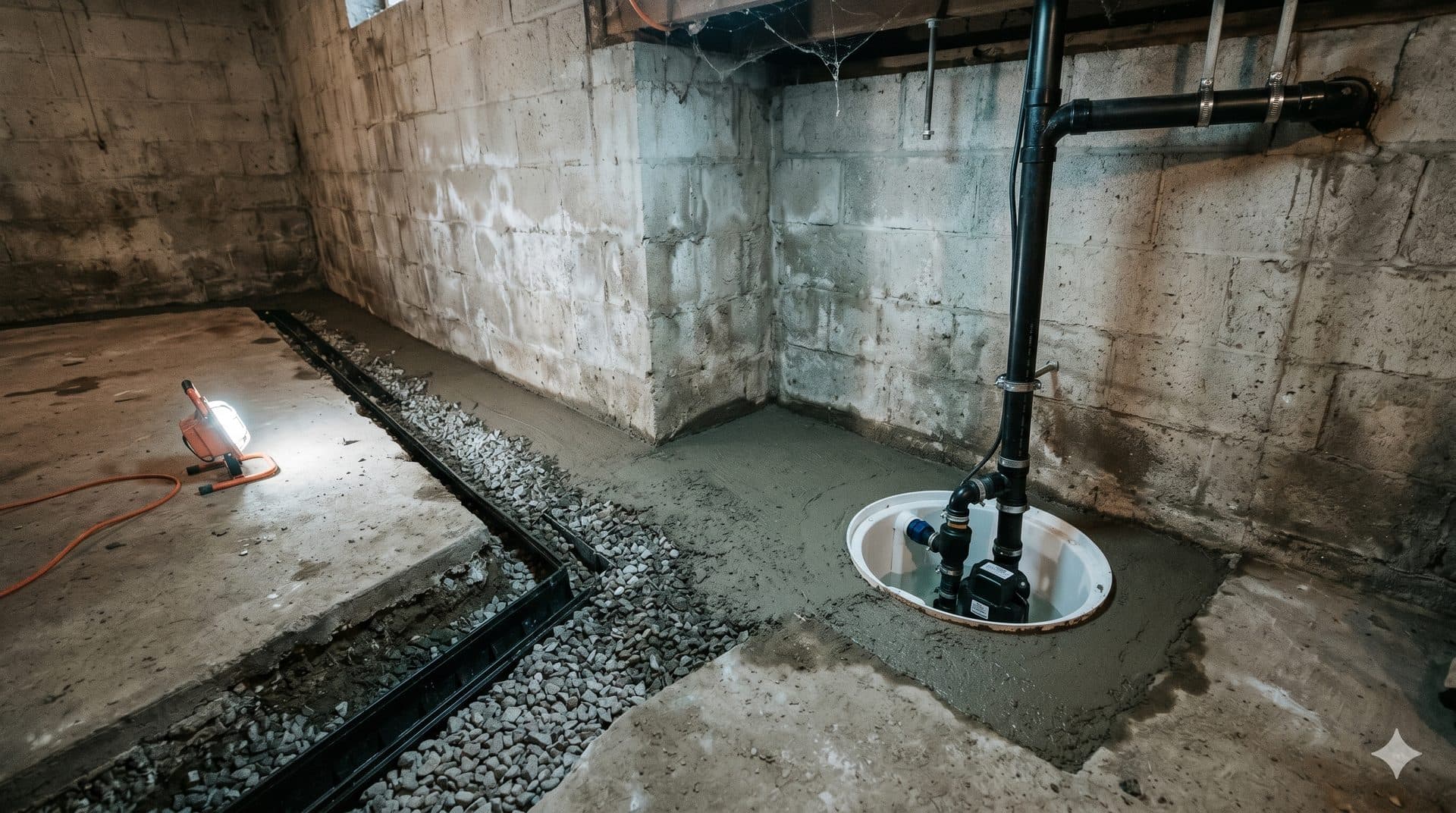
The name gets used for half a dozen different things, so here is the one we mean. An interior french drain is a perforated pipe set in a bed of stone in a trench cut along the inside edge of the basement floor, right where the floor meets the wall. It sits below the level of the slab. When groundwater rises under the house, it reaches the drain before it reaches your floor, runs along the pipe to a sump pit, and gets pumped out and away from the foundation.
That is the whole idea. It does not stop water from getting to the house. It gives the water somewhere better to go once it arrives. On the clay soils that run through the Chadakoin and Conewango valleys, where the ground holds water against the foundation for weeks at a time, that turns out to be the repair that lasts.
When a french drain is the right fix, and when it is not
This is the part most people do not get told before they buy one. A perimeter drain solves two specific problems. It is the wrong tool for the others.
It is the right fix for water at the floor joint
Water showing up in a line along the base of the wall, usually a day or two into a wet stretch, is groundwater coming up through the seam where the floor meets the wall. That seam is not sealed in most older homes and cannot be sealed in any lasting way. The drain intercepts it. This is the most common reason we install one.
It is the right fix for weeping block walls
Concrete block is hollow. Water fills the cores from outside and seeps through the inside face, leaving white mineral residue. An interior drain, paired with a wall system that lets the block cores empty into it, keeps that water moving down and out instead of sitting in the wall.
It is the wrong fix for a cracked poured wall
A vertical crack in a poured concrete wall that leaks under pressure needs to be sealed through the full thickness of the wall. A drain at the floor will catch the water that runs down, but the crack keeps working every winter. Our crack repair page covers that job. Often a house needs both, and the crack comes first.
It is the wrong fix for surface water
If the basement only gets wet during a downpour and dries out right after, the water is probably coming over the top of the foundation from a yard that slopes toward the house or from downspouts dumping at the wall. That gets fixed outside, with grading and extensions, for a fraction of the cost of any drainage system. Our wet basement repair page walks through how we tell these apart. We would rather send you to a landscaper than install something you did not need.
It is the wrong fix for a wall that is moving
A block wall that is bowing inward has to be stabilized before it is worth waterproofing. Cutting a trench along the base of a wall that is already under pressure is not something we will do until the wall is braced.
How we install one
The floor is cut and removed along the perimeter, usually a strip about a foot wide. The trench is dug below slab level and stoned. The drain pipe is set with a consistent slope toward the sump location, wrapped so silt cannot clog it, and covered with more stone. A drainage board or wall panel goes against the base of the wall so water from the block or the joint drops straight into the trench. The sump pit is set at the low point, the pump goes in, the discharge line is run out and away from the house, and the floor is patched back with concrete.
Two details separate a system that works for decades from one that fails in five years. The slope has to be right along the entire run, which is why we measure it rather than eyeball it. And the discharge has to end somewhere that cannot drain back toward the foundation, which on a small lot around here sometimes takes more thought than the drain itself.
The pump is the part of the system that actually does the work during a storm, and it deserves its own page. See sump pump systems for how we size them and why we recommend a battery backup in this area.
What it is like to live with
Nothing, mostly. You will hear the pump cycle during wet weather. The floor patch is visible unless the basement is finished over it. The system needs the pump checked once a year and the pit kept clear. Beyond that, the basement stays dry through the spring melt and the wet falls that used to put water on the floor, and it does that without anyone doing anything. That is the reason people who have one stop thinking about their basement.
French drains, common questions
What is the difference between an interior and an exterior french drain?
An interior french drain sits inside the basement, in a trench cut along the edge of the floor, and catches water after it reaches the foundation. An exterior french drain sits in the yard or against the outside of the foundation wall and intercepts water before it gets there. Interior systems are what we install for basements. Yard drains, curtain drains, and downspout drain lines are landscaping and excavation work, and if that is what your problem calls for we will tell you so rather than sell you the wrong thing.
Does a french drain fix a leaking basement wall?
It fixes water that comes up through the floor joint and water that weeps through block, because it collects both at the base of the wall. It does not seal a crack in a poured wall that is leaking under pressure partway up. Those get injected. A lot of basements need both, and the order matters: crack first, then drain.
Will an interior drain work if the house is on clay?
Clay is the reason it is needed. Clay soil holds water against the foundation instead of letting it drain away, so groundwater builds up under the slab and against the walls every wet season. The interior drain gives that water a lower place to go than your floor. On the valley soils around Jamestown, this is the standard repair for exactly that reason.
How long does installation take, and how much mess is there?
Most basements are done in one to three days depending on the perimeter length and what is in the way. The floor is opened along the wall, the trench is dug and stoned, the drain and sump are set, and the concrete is patched back. It is dusty work and anything against the walls has to move. We contain it as well as it can be contained and clean up before we leave.
Does a french drain need a sump pump?
Yes. The drain collects the water; it does not remove it. It slopes to a sump pit, and the pump lifts the water out and away from the house. A drain with a failed or undersized pump is a trench full of water. See our sump pump page for how we size and back them up.
Water coming up at the floor joint?
That is the signature of the problem a french drain solves. Call and tell us what you're seeing, and we'll set up a free on-site look before anyone talks about a system.