Basement Waterproofing in Jamestown, NY
Water in the basement is not something a house grows out of. It gets worse every spring until something changes. We find the entry point and stop it.
Why so many basements leak around here
Three things work against basements in Chautauqua County, and most wet basements we see are dealing with all three at once. The valley soils along the Chadakoin and Conewango are clay-heavy and drain slowly, so water that lands in the yard sits against the foundation instead of moving away from it. Lake-effect winters freeze that saturated ground, and frost pressure works joints and cracks open a little wider each year. And a large share of the housing stock here went up before 1940, on stone or early block walls with no footing drain, no exterior membrane, and no sump.
None of that is a defect. It is how houses were built when these neighborhoods were built. It just means the water has to be managed now, because it was never managed then.
The four ways we keep water out
Wet basement repair
The starting point for most calls. Water is coming in somewhere and the job is to find out where before anyone starts selling a system.
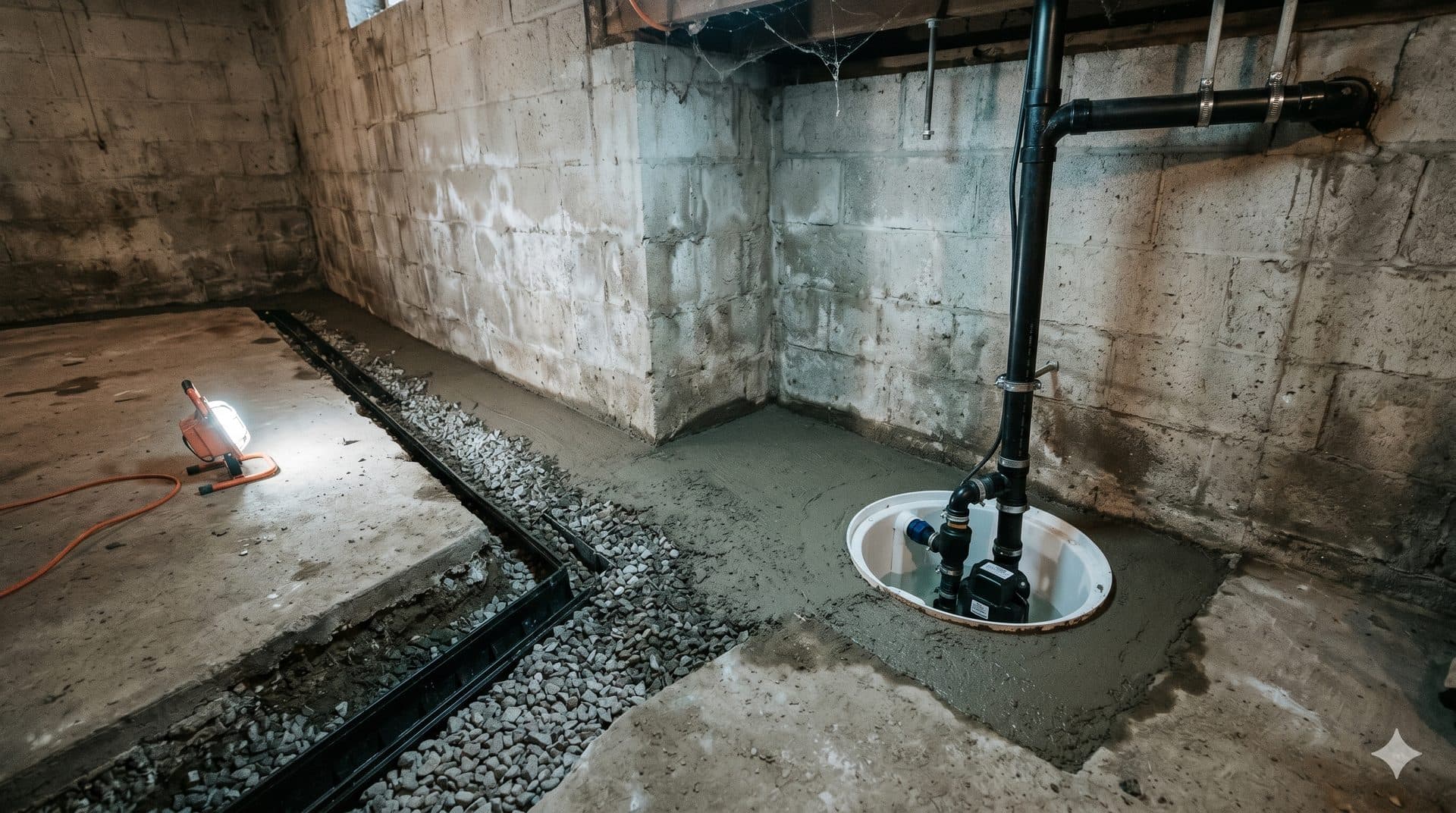
Interior french drains
A perimeter drain set below the basement floor that collects water at the wall and floor joint and carries it to a sump. This is the workhorse repair for houses on clay where groundwater rises against the foundation seasonally.
Sump pump systems
The discharge end of any interior system. Whether it is a new pit and pump or replacing one that has been failing quietly, the pump is the part that decides whether the rest of the system does anything during a storm.
Humidity and air control
Stopping liquid water does not always dry a basement out. Older basements hold moisture in the block, the slab, and the air, which is what people are smelling when they say the basement is musty. Our guide to a musty smell in the basement walks through how to tell an air problem from a water problem before calling anyone.
Each of the first three has its own page, with the detail that does not fit here.
We find the source before we quote the fix
The difference between a repair that holds and one that fails in two years is almost always diagnosis. Water entering through a cracked wall needs a different fix than water rising through the floor joint, which needs a different fix than water pouring in from a blocked window well. All three look identical when you are standing in a wet basement.
So the first visit is a look, not a pitch. If what you have is a sealing job, we will tell you that. If it is a full system, you will understand why before anyone quotes it. Our cost guide covers what actually moves the price, and the repair versus waterproofing guide is worth reading if you are not sure which problem you have. We handle basement water across our full service area, from Jamestown and the Chautauqua Lake towns north to the lake shore and west into Erie County, PA. Water and structure overlap constantly, which is why waterproofing sits alongside foundation repair as the other half of what we do.
Basement waterproofing, common questions
Is basement waterproofing the same as foundation waterproofing?
People use the terms interchangeably, and most of the time they mean the same job: stopping water from getting into a below-grade space. The distinction that actually matters is interior versus exterior. Interior work manages water once it reaches the foundation and routes it back out. Exterior work stops it before it touches the wall. Which one your house needs depends on where the water is entering and what the wall is made of.
What does basement waterproofing cost around here?
It depends almost entirely on how the water is getting in. Sealing a single leaking crack is a small job. A full perimeter drainage system with a sump pump is a much larger one. Anyone quoting a price before looking at your basement is guessing. Our cost guide walks through the factors that move the number.
Will waterproofing fix a musty smell?
Usually, though not always by itself. Musty smell means moisture is present, and stopping the water source removes the cause. In basements that have been damp for years, the fix often pairs drainage work with humidity control, because the air and the materials stay loaded with moisture even after the leaking stops.
Does a wet basement mean my foundation is failing?
Not necessarily. Plenty of structurally sound foundations take on water, and plenty of cracked walls stay dry. Water and movement are related problems but they are not the same problem. The evaluation looks at both, because the repair is different depending on which one you actually have.
Water in your basement?
Tell us where it shows up and when, and we'll set up a free on-site look. No pressure and no system sold before we know what's causing it.